
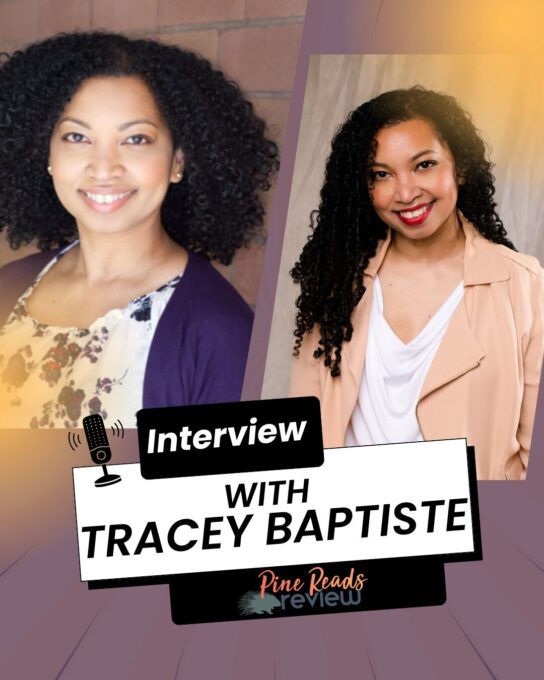
About the Author: “Tracey Baptiste the New York Times bestselling author of several works of fiction and nonfiction for children, including the Jumbies series, Marley and the Family Band, Because Claudette, and Minecraft: The Crash. Baptiste teaches in Lesley University’s creative writing MFA program and volunteers with The Brown Bookshelf. You can find her on Twitter @TraceyBaptiste and on Instagram @TraceyBaptisteWrites” (Bio from Penguin Random House’s website).
Find Tracey Baptiste on the following platforms:
Tracey Baptiste: I feel like generally when I start a project, I have a sort of idea that I’m trying to bring alive in some way. It’s usually not like a setting that I have, it usually is a character and a particular situation. And it might not be specifically from the beginning or the end or the middle of the book, it could really be from anywhere. But I’m really thinking about how would someone deal with whatever this thing is? And then from there, once I start wondering about that it brings up a whole bunch of other things. Like, you know, what if they saw something? And what might be a thing that helps them? Who might be the people around them? Where might this happen? And tiny little slivers of ideas come to me that at first don’t feel like much of anything. But eventually I’ll start noticing how those things start to fit together. So, early in my process I tend to use sticky notes, and the ideas are so small that they can very easily be jotted down in a phrase or a simple word, and then I put those up on the wall in my office. And eventually, once I’m looking at them, I start seeing the connections between the things, which then gets me to start writing a whole piece or describing one character. It might not even be the main character, but describing one character and then seeing how those things fit together.
TB: Funny enough, at the beginning of my career I really thought that I was going to write picture books. Which I think most people think that when they think about writing children’s books. They really do think of picture books because it is the most visible of the books for children: big text with pictures.
Picture books are so hard to write that I decided I would try a novel. There was a Trinidadian author named Rosa Guy who I had read when I first moved to the United States, and that was a young adult book that spoke to me so directly that I thought I wanted to do something like that, so that was really my inspiration. And I wrote this book, which at the time there wasn’t a word for it, it really was, you know, young adult or it was chapter books and picture books. And so it was billed as a young adult novel, but it really was a middle grade, there just wasn’t this language for that at the time.
And I really liked that book. I love that particular age group. It’s when I had the most fun, when I was like 11, 12, 13, that was just before I moved to the United States and I was still somewhat feral, you know. It was the 80s—early 80s, early 90s—and we were still pretty feral in the sense that our parents were not paying attention to us, and man, we got in a lot of trouble. But it was so great, and I found that that was the age group I felt the most affinity for. I mean, I’ve since written for older and younger, but I do like to write for that age group because that is the tapestry that I probably most align with.
TB: Sure. I tend to be inspired a lot by fairy tales. Those are the books that are kind of my formative introduction to literature. And I still find even now that fairy tales are still very much instructing how I look at stories. So, in Snow White we have the mother who wishes that she had a child with very particular physical traits: skin as white as snow, lips red as blood, hair black as ebony. And it occurred to me that if this mother were a Black mother who was looking at the kinds of things that happened to young Black kids, particularly young Black boys in the United States, what would she wish for her child to have? And if she were a genetic engineer, how would she make that happen? Because being a mother of Black children, that’s something that I think about.
You know, interestingly, not so much my daughter, and I think that has to do with her personality. But I look at my son and he’s the kind of person who’s going to go out in the world and do shenanigans because, you know, he has that kind of personality. He has a very irreverent personality, and I was really worried about how just doing regular kid things could be misread by someone and get him in trouble. And what would I do if I could? And it occurred to me that giving him the ability to be invisible as protection would probably be it. So that’s really the connection with Snow White, that wish that the queen has for very specific physical traits in her child.
TB: You know, he was kind of interesting because not knowing anything about the foster care system—and I knew he needed to not have a family, right? That was the whole thing with Snow White, she’s on her own. She doesn’t have a family, she winds up with this new family and she needs to figure it out herself. But I was really looking at a lot of material about kids going through the foster care system, the way they would need to rely on their own, what they could count on, what they could not count on, the kinds of experiences that they had. And the more I looked at material or listened to podcasts, or various recordings and things about kids just talking about their experiences, a very particular kind of personality was coming out: that this would be a kid who is resilient in a lot of ways, but also somebody who’s careful in social situations because they need to hang back a little bit so that they can observe and make good choices for themselves. Somebody who is maybe a little bit reckless because they don’t have, like, that anchor person. And so because of all that, that’s how his personality started to emerge.
So I was really thinking about him as this person who was coming out of the foster care system, and how that would shape a particular person to think and feel, and how he would then relate to this new family that he is placed with. How would he relate to new situations that he might find himself in? And so I’m always going back to his history as I’m trying to write him because I want to make sure, since I am not somebody who is personally familiar with that, that I am not overstepping and really trying to be mindful about the people whose stories I’ve listened to, or read, or encountered.
TB: I don’t actually know. I don’t actually have, like, a real process for how it is I do that. I knew that in this story that I wanted to lean into the whole Snow White thing. I knew that we were going to be dealing with technology and the effect technology has on kids, and how they deal with all of the various things they deal with. I knew I wanted to lean into the Black Lives Matter situation, gun violence, police violence towards Black people, and all of that.
It is a lot of sort of falls, sort of like juggling and holding in the air. I think that what I did was I was thinking about maybe one piece of it each like a scene. You have to sort of hyperfocus on the scene that you’re writing in the moment and not worry about all of the rest of it.
And I found that later on after the first draft I did have to go back, and I would go back and make sure that I had really threaded in all of the things. So I feel like the layers happened because I hyperfocused, but also because on every re-write or every future draft, I went through it thinking, are we thinking enough about the art here? Are we thinking enough about the political situation here? Are we thinking about the technology here?
TB: Yes. It had always been the plan that there would be other family members with powers. I was not sure how far I would be able to take it because it was not clear to me at the beginning whether or not even the first story would make it out into the world. But when we sent the proposal for the series, it was initially going to be three books. And I had a very specific progression: who would be in the first book, who would show up in the second book, who would show up in the third book. Currently there is not a plan for the third book, but I did always have this idea that there would be other people with powers.
TB: You know, honestly, that was me struggling personally with AI. I feel like every artist right now, visual artists, textual artists, is dealing with how AI is being used in people’s work, regurgitating it in different ways, and how it’s devaluing what we’re doing because the world’s going to be flooded with all this AI stuff. So because that has been something that a lot of artists have been dealing with, I decided that AI was something I was going to put down on the page. Because as it is, now educators are dealing with it, which means kids are dealing with it, because kids are, you know, writing essays, creating visual art.
And so I decided that Coal was going to have to grapple with these things very early on. And it seemed like a good escalation from the evil geneticist, you know, for the story to have it. It has to move from a human being to this other kind of entity, because that is a much more formidable foe for him to have to go against.
TB: One of the things that I struggle with is making sure that the whole cast has enough depth. I think that sometimes I’m so focused on the main character that it’s really difficult for me to make the rest of the cast feel like they’re real people. So I try to spend a little bit of time just kind of knowing the cast, and I do little character discovery sheets that you can do. For example, Door, you know, what’s his favorite color? Just things you can do that are never going to show up in the book, but give you a sense of who the character is beyond being a secondary or tertiary cast member. Because they’re their own main character in their own story, and they need to feel like that. So I do go through one or two worksheets to help me have a better idea of who these people are outside the whole. I feel like once I get a good sense of that, it comes to life a little bit better.
TB: First of all, read as widely as you possibly can. I mean, a lot of people feel like they want to write fantasy, or they want to write horror, or they want to write literary fiction, whatever it is, and they read a lot of that genre. What that does is great, it teaches you what you need to do for your particular genre that you’re writing within, but it doesn’t show you what else you could be doing. It actually helps you to grow when you get an idea of all these other ways of writing and other ways of putting things together. And essentially, it helps you to really find your voice. How can you go and put things together that is maybe not exactly how everybody else is doing it?
TB: There is currently no plan for the third book. We sold it as a two book series knowing that there was an idea for a third book. But at the moment, there is not a plan from the publisher to do a third book.
It’s interesting, I’m of two minds about whether or not there should be a third book. I did end Kid X specifically with that trajectory in mind. But honestly, I feel like so many things have happened since I finished writing that book to this moment, I am not sure that the trajectory I put into the end of that book is where I would want to take it next.
I mean, obviously if the publisher came back and said “Oh yeah, we definitely want the third book,” I would figure it out. But it would be difficult for sure.
Julia Smith, Pine Reads Review Writer and Editor