
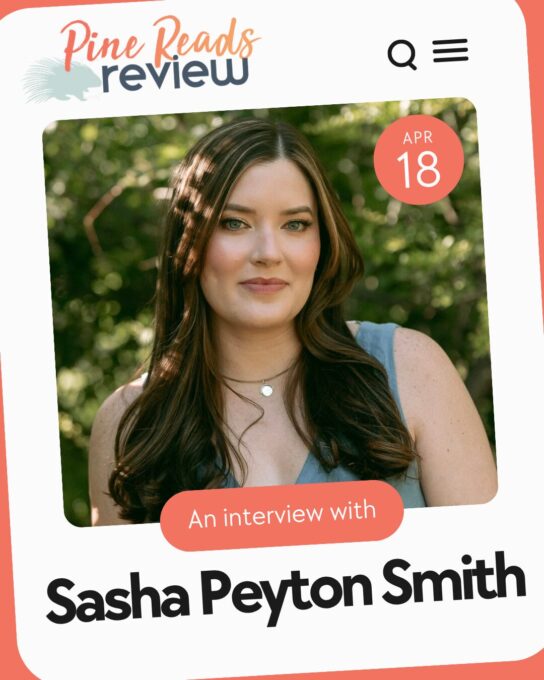
About the Interviewee: “Sasha Peyton Smith is the New York Times best-selling author of fantasy novels for young adults including The Witch Haven and The Rose Bargain. Her work has been translated into more than a dozen languages world-wide. She lives in a 100-year-old house in the mountains of Utah, with her husband and (allegedly) two ghosts, though she has yet to see them” (Bio from author’s website).
Find Sasha Peyton Smith on the following platforms:
Sasha Peyton Smith: Oh yeah, so in this story we hear from Ivy, Lydia, Emmett, and Faith. Those are the POVs in this book. I always have fun writing Emmett’s POV. It’s fun, he’s such a yearner, he’s such a little fantasy boy—I love writing Emmett. And Lydia was really fun to dive into because we only get a snippet of her perspective in the first book. And I feel like in this book we really get to dive into her psyche and why she’s done the things she’s done, what her relationship with Ivy is like from her perspective, and of course what her relationship with Bram is like from her perspective, because she has such a different relationship with him than Ivy does.
SPS: Yeah. So this group of girls have been through this vicious competition for the hand of Prince Bram, which is such a YA fantasy-trope set up, but I didn’t see a world in which they went through this together and didn’t end up friends. In my life, women have always been my biggest supporters and the biggest source of emotional intimacy, especially when I was young. And so this book is really fun because the relationships are a little bit more lived-in. In the first book, we have the awkward getting-to-know-you stage, they’re feeling each other out, they’re still each other’s competition. In this book, they all know each other quite well now. They all know where they stand with each other, there’s fewer secrets between them, and so it’s really fun to write these lived-in relationships when you’re legitimately close with your friends and you don’t feel like those walls are up anymore. And we get a lot of Marion and Faith in this book. And they are my—I mean, I guess I don’t want to say favorites. I love all my children, but their relationship is always really fun to dive into and write, especially Faith because she’s been through something so similar to Ivy, but she has such a different perspective than Ivy. I love their little foil relationship.
SPS: Yeah, so we are introduced in this book to Rhion, who’s Bram’s best friend, who is a bit of an eccentric. The thing that’s most important to know about me going into reading these books is I find immortality completely horrifying—the idea of living forever is my nightmare and just how bored it would make you. That’s kind of Mor’s thing in the first book, her cruelty is driven so much by boredom, [and] I feel like Bram’s gone insane. Infinite time has made him get a little loopy, and infinite time has made Rhion, on the other hand, like very curious about people because he’s always looking for something new. I feel like he’s always searching for new stimuli and new things to learn, and people are an endless source of fascination to him. So he’s like the more altruistic side of the coin of these fairies and what immortality can do to you. So yeah, I didn’t see a world in which he didn’t help Ivy, in which he didn’t find her very interesting. And then—no huge spoilers—he also has this connection to Lydia that was really fun to explore and this fondness and affection and protectiveness he feels over her, having witnessed the way Bram treated her after the events of [The Rose Bargain]. Writing him was really fun, I love kind of a turncoat boy—Bram thinks he’s on his side, Ivy thinks he’s on her side, who knows what side he’s on? I don’t think he knows whose side he’s on, he’s been floating through the world for like a couple millennia.
SPS: Yeah, I joke that Mor is like my ultimate boy mom—she has this like toxic forgiveness for her son. She can justify anything he does. I also think she sees her worst traits reflected back in him and it only makes her love him more. I think there’s the like, “that’s my boy” sense to all of it—I think she’s kind of proud of him. I think she’s begrudgingly quite proud of all he’s accomplished even though it’s at her expense. I think that they’re kind of toxically intertwined. I also think, given that they’re the only two immortals that have existed in England for so long, that she feels really alone in the world except for him. Everybody else feels so fleeting, but he feels quite permanent. So why would she leave him? And also, where would she go? I don’t think she has any interest in bonding with anybody else or getting to know anybody else. This is her life and this is what she wants, and ultimately, she wants him. And I don’t even think she minds losing her power as long as she doesn’t lose Bram. I think he’s her number one priority. I find her very interesting.
SPS: Yeah, I—for being a fantasy writer, writing magic systems is like the most intimidating part of my job. It’s not something that comes naturally to me and it’s not something I love doing. But you write a fairy-world fantasy, there has to be a door; that’s like a very classic trope of the fairy-fantasy, so they needed to be getting back and forth. And it was honestly the moment with Lydia in the last book that—I was just writing, I was like, “and then Lydia comes back to England, and that’s the end!” And I backed myself into a corner, and I went to go write [The Thorn Queen]—I should not confess this, this is bad writing—but I went to write book two and I was like, “How did she get through? I need to know that answer.” And I could have made it a physical door, I could have made it, you know, the tree, the magic, her emotion. But I really loved the idea that it fit into the ultimate theme of this book, which is that Bram underestimates these girls. He has granted them this power that he’s not even aware of because it wouldn’t occur to him that they could be as powerful as he is. So I guess it’s a dual answer in that it was both convenient for the corner I backed myself into in [The Rose Bargain], and it very conveniently fit my themes for [The Thorn Queen].
SPS: So Lydia and Emmett have now been trapped in the other world together for more than two years. It’s honestly kind of the opposite side of the coin of the bond Mor and Bram have in the human world: they are the only two of their kind that exists, they’re the only two that really understand what each other is going through. And Emmett and Lydia are the same way in the Otherworld: they’re the only two humans, they’re the only two who know the truth, they’re the only two who love Ivy and miss her. They’re the only two who miss London and their friends and this world that they used to live in, and they both feel very trapped. So to me, it felt natural that they would find comfort in each other and that they would become friends. Also, Emmett loves Ivy so desperately that he says in his POV, “but protecting Lydia feels like the only way to protect Ivy.” [Lydia is] his last connection to Ivy. And Emmett is Lydia’s last connection to anybody who understands the human world and anybody who wants to see her as a person. She occupies this very strange space between hostage and queen, so she’s on this strange pedestal and people don’t feel like they can get close to her. So I loved the idea that they became best friends. They had this really intense fondness for each other. But I also was writing those scenes and I was like, “people are going to be mad that they’re this close.” It’s a bit of a red herring too, I wanted people to be a little nervous. They do not have romantic feelings for each other, but those opening moments of them together, I wanted that moment of “wait, what have I missed? Oh no, oh no!” I thought it would be a little bit fun to pull at people’s heartstrings.
SPS: Those letters actually came easier to me than I think anything in the book. They were a late addition, I think they came in the second or third draft. But I spent a lot of time thinking about Ivy and Emmett and the time they spent apart. It’s interesting, I feel like this book is almost a reversal on the insta-love trope. They feel so strongly for each other in [The Rose Bargain] so immediately, and then we have Ivy now in this book and she’s reeling, thinking, “I knew him for six weeks and I told him I loved him, I told him I wanted to be with him. Was any of that real? Was that all in my head?” It’s now been months for Ivy, years for Emmett with the way time works differently in the Otherworld—which is another fairy trope I love, the mismatched timelines, because I think it’s so agonizing. So at this point they’ve spent more time missing each other than loving each other. And again, I love the letters trope. It was so fun to get into his psyche, I love torturing that poor boy, he’s like my awful little voodoo doll. And he’s so poetic and he feels so tortured, he’s such a good character to map that trope onto. Those letters flowed out of me, and I don’t even think I edited them, which is not common for me. I do not think they went through much change after they were on the page.
SPS: I think it fuels it. I think that having a sister can be so agonizing because they reflect the parts of you that you don’t like back to yourself; the things that I find annoying about my sisters are things that I find annoying in myself. Ivy and Lydia, for all of their great qualities, share the same flaws: they’re both a little blinded by love, they can both be a little rash, they can both be self-sacrificial to a fault that makes things more difficult for the people around them. In this book they are in kind of an interesting setup in that they’re feeling real resentment for each other but they’re in this competition of self-sacrifice. They would both kill and die for the other one which I think is extremely having a sister, like nobody can drive you more insane, but, don’t you dare say anything to me about my sister! Only I can say that! [That’s] very much their relationship. Their envy and their resentment, the negative feelings they have for each other, are only because they love each other so much; it’s only the intensity of that love that can match the intensity of the negative feelings. I think if they didn’t care everything would be much easier.
SPS: It’s such a classic magic trope: there needed to be a cost. But I did make sure to maintain that Ivy can still be the door so they still can access each other freely. Time is still moving for Lydia, but—I mean I don’t say this explicitly—but in my head being in the Otherworld makes her immortal. So I don’t think that Lydia is losing time but I do think it is a little bit of a tragedy for Lydia that she sacrificed so much for love and ends up isolated from Ivy [and] that she can’t go back to London. But, I guess this is kind of a spoilery-interview anyway, there’s a long epilogue where we maintain that everybody is still seeing Lydia. Everybody’s going back and forth, [Lydia] still has a strong relationship with Emmett and Ivy and their family. I picture her eventually falling in love and living a very rich life in the Otherworld. She says even herself that she never felt like she quite fit in in London, that there’s something about the Otherworld that does suit her better. But yeah, I don’t think they get to go back to England and Belgrave Square and go back to having tea together, I think they’ve been through too much. And I loved the idea that they both ended up queen. I do love that they both ended up being their respective queen. And there’s a bonus epilogue; the epilogue in the deluxe edition in the U.S. is a Lydia epilogue. We have an Ivy epilogue in the standard edition and then there is a bonus Lydia epilogue. We get a little Lydia-Rhion scene that I really loved writing.
SPS: I don’t think I can officially share anything. I will say, I have sold two more books to my existing team at HarperCollins, so I will have a book out in 2027. It will be my first YA fantasy standalone, so that’s been a fun challenge to write. In a duology, I mean, [speaking of] Lydia and the door, I feel like, “Well that’s a problem for future Sasha.” Everything when you’re writing a standalone is a problem for present Sasha. But I should be able to share more about that very soon, so standby. But I am still writing, there are more books on the horizon. No more Rose Bargain books on the horizon, but never say never, I think there’s more pockets to explore in this world.
Emersen Cooper, Pine Reads Review Writer, Editor, and Website Manager