
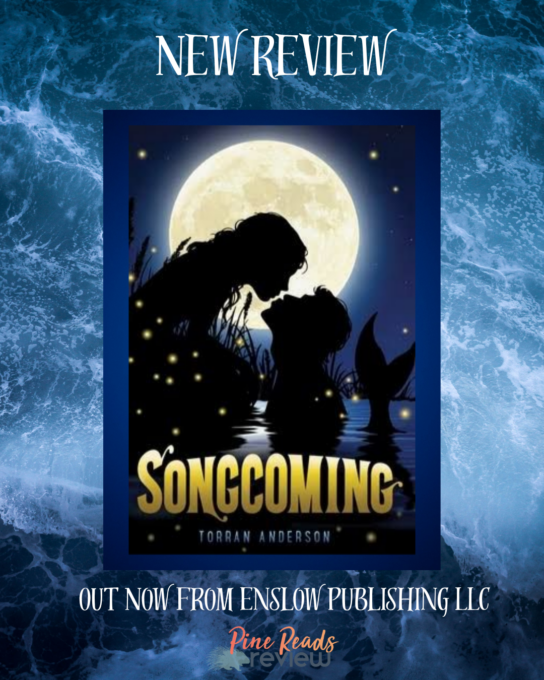
Songcoming out now from Enslow Publishing LLC; 187 pages
Content Warning: Sexual content, death, and alcohol abuse
About the Author: “Torran Anderson is the founder of the Center for Storytelling Innovation. His YA novel-in-verse, Piñata Moon, won the Paterson Prize for Books for Young People. He
has published over 50 books with educational publishers and the environmental story app Earth Day Carol. Forthcoming books include the YA novel-in-verse Songcoming (West 44 Books) and
the environmental picture book Song of the Santa Cruz River (Red Ink Press). As the director of Germination Games, he created the collaborative writing game Story Grow and the interactive Community Action deck. Torran is open to working on books, games, and community engagement projects. You can reach him at storytellinginnovation.com” (Bio from scbwi.org).
Eve is the daughter of a widowed village man, and she’s just come of age. To ensure she’s taken care of and to pay off her father’s drinking habits, she’s promised to the blacksmith’s son. Only, she sees beyond her father’s clouded judgement. Her whole life has been spent taking care of him, and she dreams of more than the remembrance of her mother. When she meets Oorin, a merman separated from his family, she finds a new passion to live for. Her desire to explore the underwater world opens her mind and heart; that is, until her father finds out. Though he tries to restrain her, Eve fights against tradition and expectations. Eve must choose her old way of life or Oorin. Perhaps two characters of different worlds can come together, but at what cost?
As a sucker for fantasy romance, rhyme, and meter, I was drawn to this mermaid tale, (pun intended!). Like some of my favorite young adult (YA) books, this is written entirely in prose poetry. Eve’s speech and thoughts have a rhythmic narrative quality, and Oorin’s thoughts are only portrayed in haikus. While an interesting choice for this pre-modern village setting, I did crave more hidden twists and nuance in the poetry elements. Oorin’s haikus reveal his wishes with the occasional only sea-based imagery. However, I would have enjoyed more of the haiku’s naturalistic side and glimpses of this world’s setting. Since he thinks mostly of Eve, it is also difficult to see his perspective. A deeper outlook on his reactions and hopes through his own voice would make him stand out more as a character. Eve’s narrative additionally serves to progress the plot, putting nuance as a second thought. Nevertheless, I found Eve’s desire for independence and her limitations as a young woman a valuable representation for the time
period. Her character is an inspiration for today’s young women. Both she and Oorin deal with familial loss and harsh cultural expectations, but they allow those factors to shape, not hinder, their choices. Eve especially demonstrates the complexity of love, family ties, and self-worth in a fitting way that’s applicable to the time period. Overall, I think this book is an easy to follow
poetry introduction for young readers, with a unique take on historical mythology. Eve and Oorin show what forming decisions means for youth romance as well as how family pasts and vulnerability can create something new.
Amelia Sommerhauser, Pine Reads Review Writer and Outreach Coordinator