
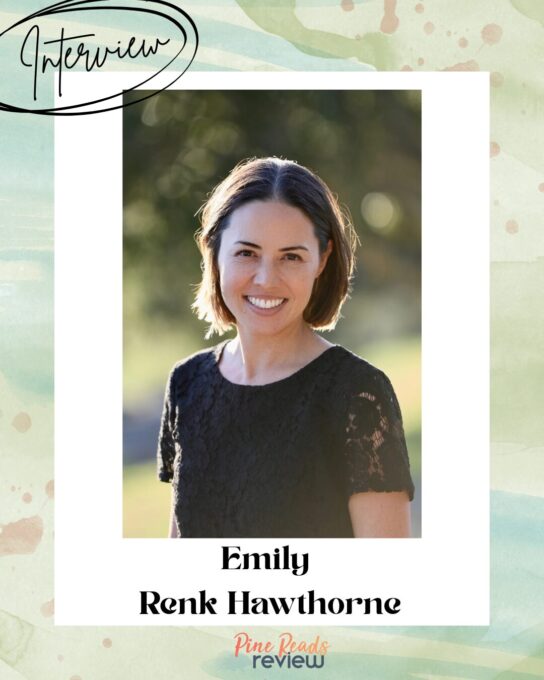
About the Interviewee: “Emily Renk Hawthorne is a general dentist who works with underserved populations. She grew up reading fantasy books and always dreamed of writing her own. Of Mountains and Seas is her debut novel. Emily grew up in Southern California and now resides on the Central Coast with her husband and child” (Bio from author’s website).
Find Emily Renk Hawthorne on the following platforms:
Emily Renk Hawthorne: One of my goals while writing Of Mountains and Seas was to explore what made a person “good” or “bad.” I wrote several POVs so I could examine how different—and sometimes surprisingly similar—backgrounds and experiences shaped each character. I also wanted to show how one person’s actions could create ripple effects that impact many other people.
EH: I think I connected most with Nivi’s POV because it felt like I was delving into my own past as a teenager and reliving some of the awkwardness that’s necessary for growth.
EH: In a way, the moral of that childhood story—strength in numbers and the importance of community—is also a theme in Of Mountains and Seas. Belonging is a driving force behind many of the characters’ actions, as is the search for connection and community.
EH: Reading about the fascinating creatures in the ancient Chinese text The Classic of Mountains and Seas inspired me to give my characters shapeshifter forms influenced by Chinese mythology. It’s also where I derived the title of the series.
EH: I originally intended to write a standalone novel focused on mystery and adventure, but by the end of Book 1 there were still many unanswered questions, so writing a second book felt natural. In general, the story also became more political than I initially imagined, though I ended up really enjoying exploring the political dynamics surrounding shapeshifters.
EH: My goal in Of Mountains and Seas was to examine individual character development, while in From the Depths that focus shifted more toward interpersonal dynamics and relationships.
EH: I started the book by writing Nivi’s POV in the year 2000 because that was the era of my own adolescence, so it felt very familiar to me. As I continued writing, though, I realized each character needed more backstory, so the timeline kept expanding further into the past. I also think there’s a greater sense of mystery and adventure in the time before the internet and cell phones. I still remember how exciting travel felt when all I had was a physical guidebook.
EH: It was definitely bringing all the characters’ storylines together. The more I wrote each character’s arc, the more they developed and began directing their own narratives. It took me a while to figure out how the characters would naturally intersect and eventually converge.
EH: I actually went back and forth between using no dates at all and using exact dates (Month/Day/Year) at the beginning of each chapter. Early feedback suggested the former was too confusing, while the latter provided too much information and distracted from the story. Even though I had a complete timeline of events guiding my writing, I realized the simpler seasonal headings were closer to how I personally track stories as a reader—a general sense of time rather than memorizing exact dates—so that ultimately felt like the best fit.
Grace McCool, Pine Reads Review Writer & Editor